The History of MMA: From Ancient Pankration to the UFC and Thailand
 MMA History
The History of MMA: From Ancient Pankration to the UFC and Thailand
Mixed Martial Arts is the fastest growing combat sport in the world — but its roots stretch back thousands of years to ancient Greece, through the fighting pits of Brazil, and into the modern global phenomenon that has transformed martial arts forever.
Part 1
Ancient Origins — Pankration and Vale Tudo
The concept of combining striking and grappling in combat is as old as human civilization itself. The earliest recorded form of MMA was Pankration — an ancient Greek combat sport that combined wrestling and striking with almost no rules. Pankration was introduced to the Olympic Games in 648 BC and was considered one of the most prestigious athletic competitions in the ancient world.
The word Pankration comes from the Greek words pan (all) and kratos (strength or power) — literally meaning “all powers.” Competitors could strike, throw, choke, and apply joint locks. The only prohibited techniques were eye gouging and biting. Matches continued until one competitor submitted, was knocked unconscious, or conceded defeat.
Fast forward to 19th and early 20th century Brazil, where a similar concept emerged in the form of Vale Tudo — Portuguese for “anything goes.” Vale Tudo matches were held in circus tents and public venues across Brazil, pitting fighters from different martial arts disciplines against each other with minimal rules. It was in this environment that the Gracie family began testing and refining Brazilian Jiu-Jitsu against all comers — laying the groundwork for modern MMA.
Part 2
The Birth of Modern MMA — UFC 1, 1993
The event that truly launched modern MMA was the first Ultimate Fighting Championship, held on November 12, 1993 in Denver, Colorado. The tournament was conceived by Rorion Gracie and businessman Art Davie as a platform to answer the age-old question: which martial art is most effective in a real fight?
Eight fighters representing different martial arts disciplines — boxing, wrestling, kickboxing, Savate, Sumo, and Brazilian Jiu-Jitsu — competed in a single-night tournament with minimal rules. No rounds. No judges. Victory by submission, knockout, or the opponent’s corner throwing in the towel.
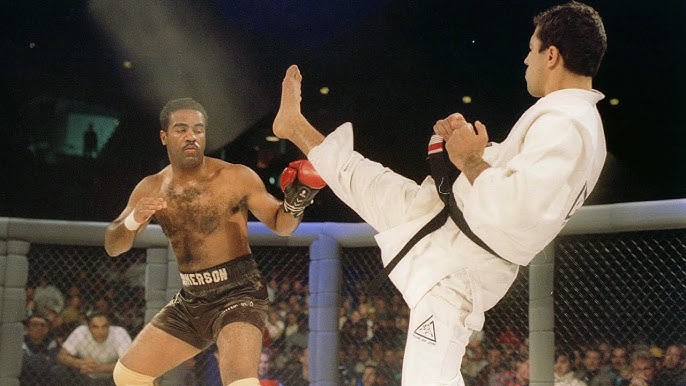
The Gracie family sent Royce Gracie — a lean, unimposing 26-year-old — to represent BJJ. What happened next shocked the martial arts world. Royce submitted three opponents in one night, defeating fighters who outweighed him significantly, using ground fighting and submission techniques that most viewers had never seen before.
UFC 1 — November 12, 1993
“Eight fighters. One night. No rules. Royce Gracie submitted every opponent he faced — and Brazilian Jiu-Jitsu changed the world of martial arts forever.”
Royce went on to win UFC 1, UFC 2, and UFC 4 — defeating 11 opponents across three tournaments. His dominance proved beyond doubt that ground fighting and submission grappling were essential skills for any complete fighter. The age of the single-discipline martial artist was over.
Part 3
The Evolution of MMA — From Spectacle to Sport
The early UFCs were raw and unregulated — and attracted significant controversy. Senator John McCain famously called it “human cockfighting” and lobbied to have it banned from cable television. By the late 1990s, MMA had been removed from pay-per-view in the United States and the UFC was struggling financially.
The turning point came in 2001 when Dana White and the Fertitta brothers purchased the UFC for $2 million. They worked with athletic commissions to develop a proper regulatory framework — introducing weight classes, rounds, a unified set of rules, and mandatory safety equipment. MMA was transformed from a spectacle into a legitimate sport.
The real breakthrough came with The Ultimate Fighter reality TV show in 2005, which introduced MMA to a mainstream American audience. The finale between Forrest Griffin and Stephan Bonnar — widely considered one of the greatest fights in MMA history — aired live on Spike TV and attracted massive viewership, launching MMA into the mainstream.
How MMA Rules Evolved
→
1993 — UFC 1 No rounds, no time limits, almost no rules. Victory by submission or stoppage only.
→
Late 1990s Weight classes introduced. Basic safety rules added. Fighter gloves required.
→
2000 New Jersey State Athletic Control Board adopts the Unified Rules of MMA.
→
2001–present MMA fully regulated globally. Recognized as a legitimate sport in most countries.
Part 4
The Disciplines That Make Up MMA
Modern MMA requires proficiency across multiple combat ranges and disciplines. The most successful MMA fighters are well-rounded athletes who can fight effectively on their feet, in the clinch, and on the ground.
Striking Boxing, Muay Thai, and kickboxing form the foundation of MMA striking
Wrestling Takedowns, clinch control, and cage work — essential for controlling where the fight happens
BJJ & Judo Ground fighting, submissions, and throws — the foundation of MMA’s grappling game
At Mastery Martial Arts we teach all three grappling disciplines — BJJ, Judo, and MMA — giving our students the most complete martial arts foundation available in one gym in Phutthamonthon, Bangkok.
Part 5
Major MMA Organizations Around the World
Today MMA is a global sport with professional organizations on every continent. Here are the major promotions:
| Organization | Region | Founded |
|---|---|---|
| UFC — Ultimate Fighting Championship | Global (USA-based) | 1993 |
| ONE Championship | Asia (Singapore-based) | 2011 |
| Bellator MMA | USA / Europe | 2008 |
| RIZIN Fighting Federation | Japan | 2015 |
| GAMMA — Global Association of MMA | International amateur | 2012 |
| TAMMA — Thai Amateur MMA Association | Thailand | — |
Part 6
MMA in Thailand — A Rising Force
Thailand has long been the world capital of Muay Thai — but over the past two decades, MMA has taken root and grown into a serious competitive scene. The country’s deep martial arts culture, combined with the growing influence of BJJ and wrestling, has produced a new generation of Thai MMA fighters capable of competing on the world stage.
Organizations like TAMMA (Thai Amateur MMA Association) and international bodies like GAMMA have provided Thai athletes with competitive platforms. ONE Championship — headquartered in Singapore — has featured Thai fighters prominently and brought world-class MMA to Asian audiences.
Perhaps the most remarkable example of Thailand’s MMA potential is Coach Amp (Kanjutha Phattaraboonsorn) — a Mastery Martial Arts coach who is not only a BJJ Black Belt but also a GAMMA World MMA Champion (2024 and 2025), SEA Games 2025 Gold Medalist, and World Games 2022 Champion. Her achievements prove that Thai fighters can compete and win at the absolute highest levels of international MMA.
648 BC
Pankration introduced to the ancient Greek Olympic Games
1920s–1950s
Vale Tudo matches held across Brazil — Gracie family tests BJJ against all styles
1993
UFC 1 held in Denver — Royce Gracie wins, BJJ and MMA go global
2001
UFC purchased by Dana White and Fertittas — MMA becomes a regulated sport
2005
The Ultimate Fighter airs on Spike TV — MMA enters the mainstream
2011
ONE Championship founded — MMA becomes Asia’s biggest combat sport
2022–2025
Coach Amp wins World Games, GAMMA Worlds, and SEA Games — Thai MMA on top of the world
Train MMA in Bangkok at Mastery Martial Arts
At Mastery Martial Arts in Phutthamonthon, Bangkok, you train MMA under Coach Kyo — BJJ Purple Belt and Thai National MMA Coach who developed World Champion Coach Amp. Whether you are a complete beginner or an experienced fighter, your first class is completely free.
Book Your Free Trial Class →