The BJJ Belt System Explained
Brazilian Jiu-Jitsu is one of the few martial arts in the world where earning a black belt can take over a decade. The belt system is not just a ranking — it is a philosophy, a culture, and a commitment for life.
Part 1 Why the BJJ Belt System is Different
Most martial arts award black belts in 3–5 years. In Brazilian Jiu-Jitsu, the average time to black belt is 10–15 years. This is not an accident — it is by design.
BJJ was built on the principle that technique must be proven in live, resisting training (called “rolling”). You cannot fake your way through a BJJ belt promotion. Every stripe, every belt is earned against real opponents who are actively trying to submit you.
Hélio Gracie, one of the founders of BJJ, famously said that a black belt is simply a white belt that never quit. The philosophy behind the belt system is one of relentless, patient progression.
Did You Know?
The IBJJF (International Brazilian Jiu-Jitsu Federation) sets minimum time requirements for each belt. A practitioner cannot be promoted to black belt in less than 8–10 years, regardless of skill level. This protects the integrity of the art worldwide.
Part 2 The Belt Colors Explained
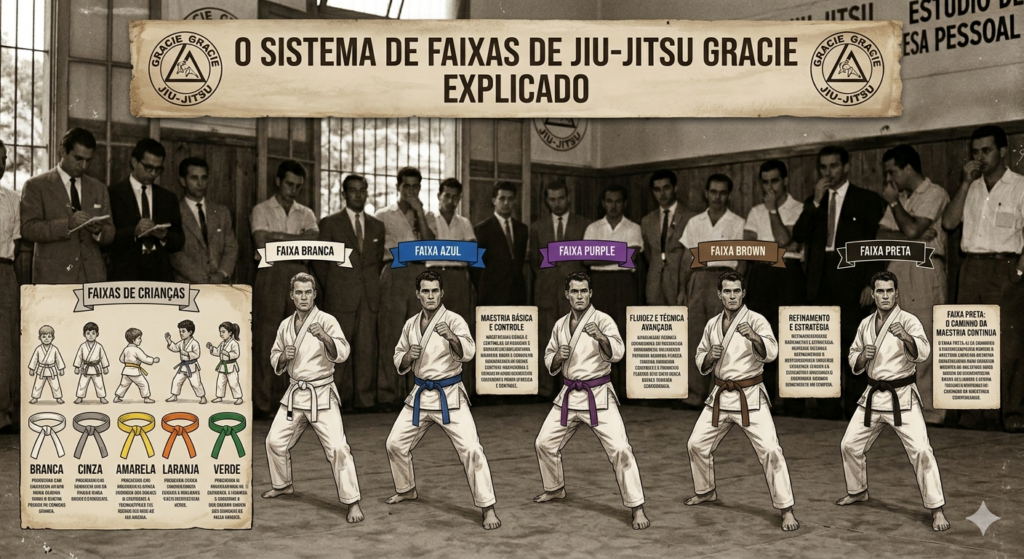
BJJ has five main adult belt colors, each with up to four stripes that mark progress within that belt. The journey from white to black belt is one of the most demanding progressions in all of sport.
White Belt
0 – 2 years
The beginning of the journey. Focus is on survival, basic positions, and building a foundation. Everyone starts here — there are no shortcuts.
Blue Belt
2 – 5 years
The student has survived the hardest part. Blue belt means you understand the fundamentals and can defend yourself against untrained opponents with ease. Often the longest belt to hold.
Purple Belt
4 – 7 years
A pivotal rank. Purple belts are expected to start developing their own game and teach lower belts. This is where BJJ truly becomes personal.
Brown Belt
6 – 10 years
The final stage before black. Brown belts have mastered the fundamentals and are refining their game. Many consider this the most enjoyable belt — pressure is off, artistry takes over.
Black Belt
10 – 15+ years
One of the most respected achievements in all martial arts. A BJJ black belt represents not just skill, but years of dedication, sacrifice and love for the art.
Red/Black & Red/White
25 – 50+ years
The coral belt (7th degree) and red belt (9th–10th degree) are reserved for those who have dedicated their entire lives to BJJ. Fewer than 50 people in the world hold a 9th or 10th degree red belt.
Part 3 IBJJF Minimum Time Requirements
The International Brazilian Jiu-Jitsu Federation sets official minimum time requirements to ensure global standards. These are minimums — most practitioners take significantly longer.
| Belt | Minimum Time at Previous Belt | Minimum Age |
|---|---|---|
| Blue | No minimum (from white) | 16 years |
| Purple | 2 years at blue | 16 years |
| Brown | 1.5 years at purple | 18 years |
| Black | 1 year at brown | 19 years |
| Black 2nd degree | 3 years at 1st degree | — |
| Coral (7th) | 7 years at 6th degree | — |
| Red (9th–10th) | 10 years at 8th degree | — |
Part 4 The Kids Belt System
BJJ has a separate ranking system for children aged 4–15. Unlike adults, kids have a more colorful and gradual progression designed to keep them motivated and engaged.
Kids Belt Order (Age 4–15)
- White
- Grey/White → Grey → Grey/Black
- Yellow/White → Yellow → Yellow/Black
- Orange/White → Orange → Orange/Black
- Green/White → Green → Green/Black
- Blue belt (from age 16, adult system begins)
At Mastery Martial Arts, our kids program (age 6–12) follows this system. Children train in a safe, structured environment and progress at their own pace with guidance from our certified coaches.
Part 5 What Gets You Promoted?
There is no single formula for belt promotion in BJJ. Unlike Judo or Karate, there is no fixed syllabus or grading exam. Promotions are entirely at the discretion of your instructor and are based on a holistic assessment of your progress.
Most instructors look at a combination of factors:
What Instructors Look For
- Technical knowledge — Can you execute and defend techniques correctly?
- Performance in rolling — How do you perform against training partners at your level and above?
- Competition results — Not always required, but competition experience accelerates growth.
- Consistency — How often do you train? Gaps in training slow progression significantly.
- Character — Attitude, respect for training partners, and contribution to the gym culture all matter.
- Teaching ability — At higher belts, can you explain and demonstrate techniques to others?
“A black belt is a white belt who never quit.” — Hélio Gracie, co-founder of Brazilian Jiu-Jitsu
Part 6 BJJ Belts in Bangkok — What to Expect
Bangkok has one of the most active BJJ scenes in Southeast Asia. With multiple tournaments held throughout the year — including the AFG Open International, organised by Professor Thien of Mastery Martial Arts — there are plenty of opportunities to test yourself.
Bangkok BJJ practitioners are competitive. Training at a gym with a legitimate lineage, regular competition exposure, and high-quality rolling partners will accelerate your progress significantly compared to training at lower-level facilities.
Mastery Martial Arts Belt Lineage
Head Coach Professor Thien Krua-Chottikul holds a 1st Degree BJJ Black Belt under the Pedro Sauer lineage — one of the most respected lineages in the world, tracing directly back to Helio Gracie through Rickson Gracie and Pedro Sauer himself. This means every belt awarded at Mastery Martial Arts carries genuine, verifiable lineage.
Ready to Start Your BJJ Journey?
Train under a legitimate Pedro Sauer lineage black belt in Bangkok. Your first class is free.
Book a Free Trial ClassReady to start your BJJ journey? Book a free trial class at Mastery Martial Arts, Bangkok — no experience needed.