The History of Judo: From the Samurai to the Olympics and Bangkok
 Judo History
The History of Judo: From the Samurai to the Olympics and Bangkok
Judo is one of the world’s most practiced martial arts and an Olympic sport — but its story begins with a single visionary young scholar in 19th century Japan who dared to reimagine how human beings could fight, move, and live.
Part 1
The Samurai Roots — Japanese Jujutsu
Before Judo, there was Jujutsu — a comprehensive combat system developed by Japanese samurai warriors over centuries of battlefield use. Jujutsu (also written as Jujitsu or Ju-jitsu) was designed for combat against armed and armored opponents, incorporating throws, joint locks, chokes, strikes, and weapons techniques.
The word Jujutsu means “the art of softness” or “the yielding art” — reflecting its core principle of using an opponent’s force and momentum against them rather than meeting force with force. This philosophy of ju (yielding, flexibility) would become the cornerstone of all Japanese martial arts that followed.
By the 19th century, hundreds of different Jujutsu schools (called ryū) existed across Japan, each with their own techniques, traditions, and philosophies. While effective, Jujutsu training was often dangerous, secretive, and lacked a unified system. It was into this fragmented world that a young scholar named Jigoro Kano would step — and change everything.
Part 2
Jigoro Kano — The Father of Judo
Jigoro Kano was born on October 28, 1860, in Mikage, Japan. As a young man he was physically small and often bullied — which drove him to seek out martial arts training. He began studying Jujutsu under several masters, eventually becoming highly skilled in multiple schools of the art.
But Kano was not just a fighter — he was a visionary educator. He saw that Jujutsu’s most dangerous techniques made serious practice impossible, and that its secretive, school-based nature prevented it from reaching its full potential. He set out to create something new: a martial art that preserved the most effective techniques of Jujutsu while making it safe enough to practice at full intensity.
In 1882, at the age of 21, Kano founded the Kodokan — his school of the new art he called Judo, meaning “the gentle way.” The Kodokan opened with just nine students in a small room at the Eishoji Buddhist temple in Tokyo. Within years it would grow into one of the most influential martial arts institutions in the world.
Jigoro Kano — Key Facts
→
Born October 28, 1860 — Mikage, Japan
→
Founded Judo 1882 — opened the Kodokan in Tokyo with 9 students
→
Olympic contribution First Asian member of the International Olympic Committee (1909)
→
Philosophy “Maximum efficiency with minimum effort” and “mutual welfare and benefit”
→
Legacy Judo is now practiced by over 20 million people in 200+ countries
Part 3
The Principles of Judo — More Than a Martial Art
What made Judo revolutionary was not just its techniques — it was the philosophy behind them. Kano built Judo around two core principles that went far beyond the dojo:
Seiryoku Zenyo — Maximum efficiency with minimum effort. Use your opponent’s energy and momentum against them. Work smarter, not harder. This principle applies not just in combat but in all aspects of life.
Jita Kyoei — Mutual welfare and benefit. Training should benefit both partners. Judo is not about defeating your opponent — it is about growing together. This philosophy made Judo fundamentally different from the secretive, combative culture of traditional Jujutsu schools.
Kano also introduced the concept of randori — free practice where two judoka (Judo practitioners) spar at near full intensity using all their techniques. By removing the most dangerous strikes and focusing on throws, pins, chokes, and joint locks, Kano created a system where practitioners could train realistically without serious injury — a revolutionary idea at the time.
Kano’s Vision
“The purpose of Judo is to perfect oneself and to contribute to society. A judoka who only thinks of winning has missed the point entirely.”
Part 4
Judo’s Famous Throwing Techniques
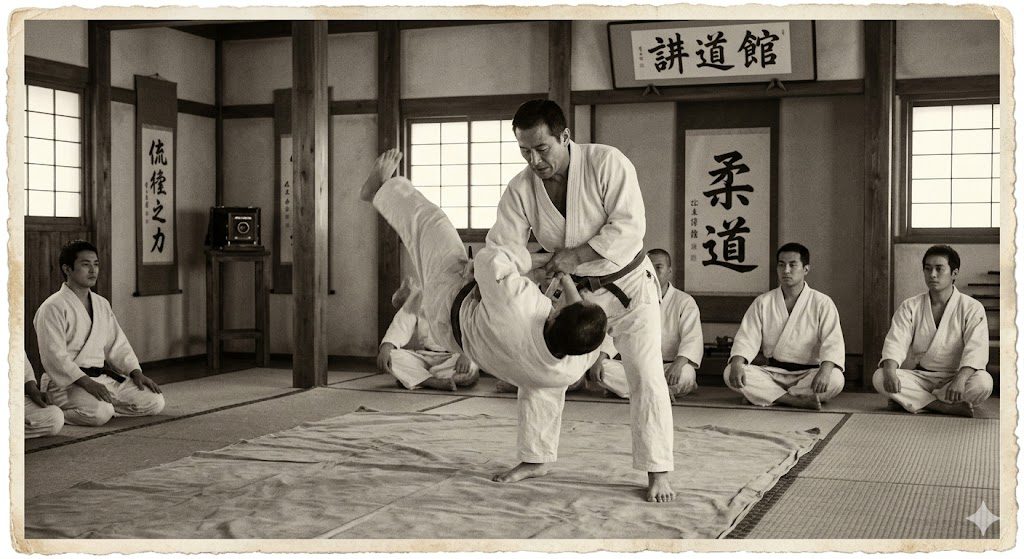
Judo’s throwing arsenal — called nage-waza — is one of the most technically refined collections of throwing techniques in all of martial arts. Here are some of the most famous and widely used Judo throws:
O-goshi Major Hip Throw One of the first throws learned — using the hip to load and throw the opponent over the back
Seoi-nage Shoulder Throw Perhaps the most iconic Judo throw — loading the opponent onto the back and throwing forward
Harai-goshi Sweeping Hip Throw Sweeping the opponent’s leg while rotating the hip for a powerful throw
Uchi-mata Inner Thigh Throw A sweeping throw targeting the inner thigh — one of the most used throws in competition
Osoto-gari Major Outer Reap Reaping the opponent’s leg from the outside while driving them backward
Tomoe-nage Circle Throw A sacrifice throw using the foot on the hip to launch the opponent overhead
Part 5
Judo Becomes an Olympic Sport
Judo’s path to the Olympics was driven in large part by Jigoro Kano himself. In 1909, Kano became the first Asian member of the International Olympic Committee — a position he used to advocate for Judo’s inclusion in the Games.
His dream was finally realized — albeit posthumously — when Judo became an Olympic sport at the 1964 Tokyo Games, making it the first and only martial art to be included in the Olympics at that time. The choice of Tokyo was deeply symbolic — Judo returning to its homeland on the world’s biggest sporting stage.
Today Judo is one of the most widely practiced Olympic sports in the world, with competitions held across five weight categories for both men and women. The Olympic Judo tournament is considered one of the most prestigious titles in the sport.
Judo at the Olympics — Key Milestones
→
1964 — Tokyo Judo debuts as an Olympic sport. Japan wins 3 of 4 gold medals.
→
1972 — Munich Judo returns after being absent from Mexico City 1968. Weight categories introduced.
→
1992 — Barcelona Women’s Judo added to the Olympic program for the first time.
→
2024 — Paris Judo mixed team event introduced. France dominates on home soil.
Part 6
The Judo Belt System
Judo introduced the colored belt ranking system that is now used across almost all martial arts worldwide. Kano created the belt system to provide students with clear goals and recognition for their progress.
| Belt | Level | What It Represents |
|---|---|---|
| White | Beginner | The starting point — a blank canvas ready to learn |
| Yellow | 6th Kyu | Basic throws and groundwork understood |
| Orange | 5th Kyu | Growing technical repertoire and randori experience |
| Green | 4th Kyu | Solid fundamentals, beginning to develop personal style |
| Blue | 3rd Kyu | Advanced techniques and competition experience |
| Brown | 1st–2nd Kyu | Near black belt level — refined technique and strategy |
| Black | 1st Dan and above | Mastery — demonstrated through years of technical excellence |
Part 7
Judo’s Connection to BJJ and MMA
One of Judo’s most far-reaching legacies is its direct role in the creation of Brazilian Jiu-Jitsu. When Judo master Mitsuyo Maeda — one of Kano’s most accomplished students — traveled to Brazil in 1914, he taught his techniques to Carlos Gracie. The Gracie family then adapted and refined these techniques, with an emphasis on ground fighting, eventually creating BJJ.
This means that every time you train BJJ, you are practicing techniques that trace directly back to Jigoro Kano’s Kodokan. Judo and BJJ are siblings — born from the same parent art, developed in different directions, and most powerful when trained together.
In MMA, Judo throws have proven devastatingly effective. Fighters like Ronda Rousey (who was an Olympic Judo bronze medalist before becoming a UFC champion), Fedor Emelianenko, and Hector Lombard have all used Judo-based takedowns and throws to dominate opponents in the cage and ring.
1882
Jigoro Kano founds Judo and opens the Kodokan in Tokyo with 9 students
1900s
Judo spreads across Japan and begins expanding internationally
1914
Mitsuyo Maeda brings Judo to Brazil — directly leading to the creation of BJJ
1909
Kano becomes first Asian IOC member — begins campaigning for Olympic inclusion
1964
Judo debuts at the Tokyo Olympic Games — the first martial art in Olympic history
1992
Women’s Judo added to the Olympics at Barcelona
2008–present
Ronda Rousey wins Olympic bronze — Judo throws dominate MMA worldwide
Part 8
Judo in Thailand
Judo has a long and successful history in Thailand. Thai Judo athletes have competed at the Olympic Games, Asian Games, and SEA Games, consistently punching above their weight on the international stage.
Thailand’s martial arts culture — already deeply rooted in Muay Thai — has embraced Judo as both a competitive sport and a complement to MMA training. As MMA has grown in Thailand, so has interest in Judo’s throwing techniques among fighters looking to add powerful takedowns to their game.
At Mastery Martial Arts in Phutthamonthon, we teach Judo as part of our complete martial arts curriculum alongside BJJ and MMA — giving our students the most well-rounded grappling education available in Bangkok.
Train Judo in Bangkok at Mastery Martial Arts
At Mastery Martial Arts in Phutthamonthon, Bangkok, we teach Judo to complete beginners and experienced practitioners in a welcoming, structured environment. Train Judo alongside BJJ and MMA — the most complete martial arts education under one roof. Your first class is completely free.
Book Your Free Trial Class →