The History of Brazilian Jiu-Jitsu: From Japan to Brazil to Bangkok
BJJ History
The History of Brazilian Jiu-Jitsu: From Japan to Brazil to Bangkok
Brazilian Jiu-Jitsu is one of the most effective martial arts in the world today — but its journey from the dojos of Japan to the streets of Brazil and eventually to gyms across Bangkok is a story of passion, adaptation, and generations of dedicated practitioners.
Part 1
The Japanese Roots — Judo and Jujutsu
The story of BJJ begins in Japan with the ancient art of Jujutsu — a comprehensive combat system developed by samurai warriors that included throws, joint locks, chokes, and strikes. Jujutsu was designed for battlefield use, allowing a smaller warrior to defeat an armored opponent using leverage and technique rather than strength.
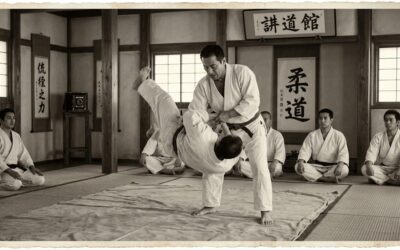
In 1882, a young Japanese scholar named Jigoro Kano took the most effective elements of Jujutsu and created a refined, safer system he called Judo — meaning “the gentle way.” Kano opened the Kodokan dojo in Tokyo and began developing Judo into both a martial art and a sport, emphasizing the principle of maximum efficiency with minimum effort.
One of Kano’s most talented students was Mitsuyo Maeda — a man whose journey would change the course of martial arts history forever.
Part 2
Mitsuyo Maeda — The Bridge Between Japan and Brazil
Mitsuyo Maeda was born in Japan in 1878 and became one of the most accomplished Judo practitioners of his generation. After training under Jigoro Kano at the Kodokan, Maeda embarked on a remarkable global journey — traveling to the United States, Europe, Cuba, Mexico, and eventually South America, challenging fighters of all styles along the way.
In 1914, Maeda arrived in Brazil. He eventually settled in the city of Belém in the Amazon region, where he began teaching Judo and offering public demonstrations. It was here that he met a young Brazilian named Carlos Gracie — and the history of BJJ was born.
Mitsuyo Maeda — Key Facts
→
Born 1878, Aomori Prefecture, Japan
→
Trained under Jigoro Kano at the Kodokan, Tokyo
→
Arrived in Brazil 1914 — settled in Belém, Amazon region
→
Legacy Taught Carlos Gracie — directly leading to the creation of BJJ
Part 3
The Gracie Family — Transforming Judo into BJJ
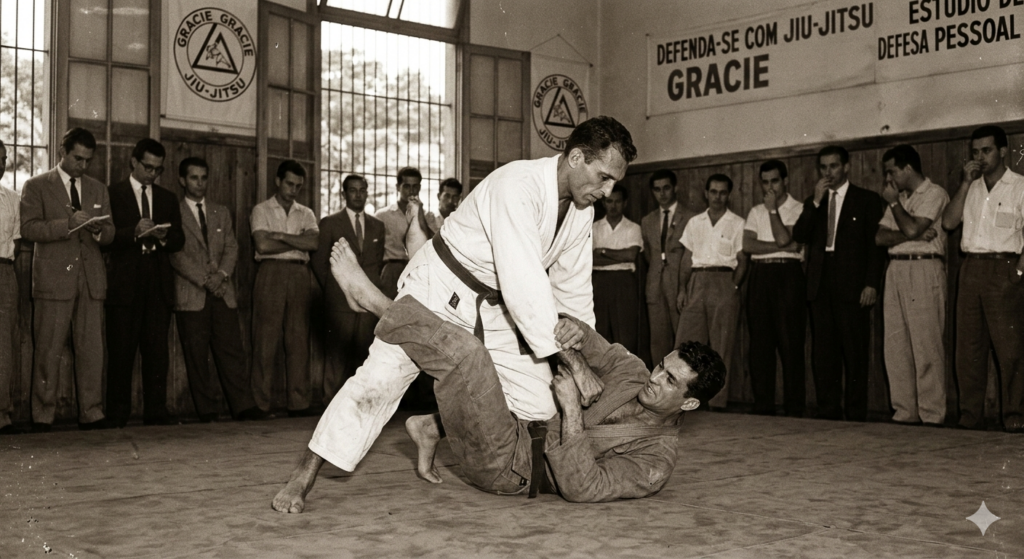
Carlos Gracie was a teenager when he first began learning from Mitsuyo Maeda in the early 1920s. He later moved to Rio de Janeiro with his brothers and opened the first Gracie Academy in 1925.
But it was his younger brother Hélio Gracie who would have the most profound impact on the development of BJJ. Hélio was physically smaller and frailer than his brothers, and found that many standard Judo techniques required strength he did not possess. Out of necessity, Hélio began modifying the techniques — emphasizing leverage, timing, and body mechanics over strength and athleticism.
This process of adaptation is the philosophical foundation of Brazilian Jiu-Jitsu: a smaller, weaker person can successfully defend against and defeat a larger, stronger opponent through superior technique.
The Gracie Philosophy
→
Leverage over strength Use body mechanics and positioning, not muscle
→
Ground fighting supremacy Most real fights end on the ground — control it
→
Constant testing The Gracie family issued open challenges to prove their art worked
→
Accessible to all Men, women, children — anyone can learn BJJ regardless of size
Part 4
The UFC and BJJ’s Global Breakthrough
The event that truly brought BJJ to worldwide attention was the first Ultimate Fighting Championship (UFC) tournament, held in Denver, Colorado in November 1993.
The Gracie family sent Royce Gracie — a lean, unimposing young man — to represent BJJ. What happened next shocked the martial arts world. Royce defeated fighters from boxing, wrestling, kickboxing, and Savate using BJJ’s ground fighting and submission techniques. He won the 1st, 2nd, and 4th UFC tournaments, cementing BJJ’s place as the most effective ground fighting art in the world.
Royce Gracie at UFC 1 — 1993
“A lean Brazilian fighter nobody had heard of submitted every opponent he faced — boxers, wrestlers, kickboxers — using ground fighting techniques that most of the world had never seen. BJJ was never the same again.”
Part 5
The BJJ Belt System
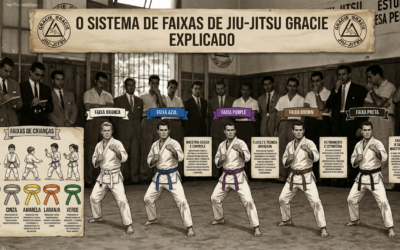
BJJ uses a belt ranking system to denote progression. Unlike many other martial arts, BJJ belts are notoriously difficult to earn — making a BJJ black belt one of the most respected achievements in all of martial arts.
| Belt | Average Time | What It Means |
|---|---|---|
| White | 0–1 year | Beginner — learning survival and basic positions |
| Blue | 1–3 years | Solid fundamentals, basic attacks and defenses |
| Purple | 3–6 years | Advanced technique, developing a personal game |
| Brown | 6–9 years | Refining and mastering all positions |
| Black | 10–15 years | Mastery — one of the hardest belts in martial arts to achieve |
Part 6
BJJ in Thailand — From Bangkok to the World Stage
BJJ arrived in Thailand gradually through the 1990s and 2000s, initially practiced mainly by expatriates and international fighters training in the country’s famous Muay Thai camps. As Thailand’s martial arts scene evolved and MMA grew in popularity, BJJ became an essential component of any serious fighter’s training.
Today Bangkok has a growing and vibrant BJJ community, with regular tournaments, seminars, and a new generation of Thai BJJ practitioners competing and winning on the international stage.
Thai athletes like Coach Amp (Kanjutha Phattaraboonsorn) — a BJJ Black Belt, World Games 2022 Champion, and SEA Games 2025 Gold Medalist — have proven that Thailand can produce world-class BJJ athletes who compete at the highest levels globally.
1882
Jigoro Kano founds Judo and opens the Kodokan in Tokyo
1914
Mitsuyo Maeda arrives in Brazil and meets Carlos Gracie
1925
Carlos Gracie opens the first Gracie Academy in Rio de Janeiro
1993
Royce Gracie wins UFC 1 — BJJ goes global
2000s
BJJ arrives in Thailand, growing alongside MMA
2022
Coach Amp wins The World Games in Birmingham — Thai BJJ on the world stage
Train BJJ in Bangkok at Mastery Martial Arts
At Mastery Martial Arts in Phutthamonthon, Bangkok, we carry on this rich tradition — teaching BJJ to complete beginners and experienced practitioners alike under the guidance of Coach Amp, a BJJ Black Belt and internationally decorated champion. Your first class is completely free.
Book Your Free Trial Class →